Showing posts with label electric guitar. Show all posts

Monday, May 09, 2022

7 Best Multi-Effects Guitar Pedals in 2022

Guitar pedals are one of the most important accessories a guitarist can have. They can drastically change your sound, and there are a ton of different types to choose from. If you’re looking for the best multi-effects guitar pedals for your money, then you’ve come to the right place.

1. Zoom G3N


The Zoom G3N is one of the best multi-effects pedals on the market. It’s affordable, yet it offers a ton of features. With over 100 different effects, you can create any sound you want with this pedal. It also has a built-in looper, which is great for practicing and songwriting. 

It’s true bypass, so no matter what effect you have engaged, your guitar will remain clean. In order to make this multi-effect pedal affordable for all players, Line 6 has made it very compact. 

The G3N comes with a 9V battery which can power this pedal for up to 18 hours. This is great for transportability and you can use this pedal with the optional power supply. The G3N has two channels, clean and overdrive. The clean channel has a light boost, treble cut, bass cut, and volume knob. The overdrive channel is comprised of a gain knob that allows you to adjust your level of distortion according to your needs. 

These are both foot-switchable so you can switch between the two channels via your foot while playing. The G3N also has a preamp out, which is great for connecting to either an amplifier or recording device. With both channels and a very flexible amp model section, the G3N is one of the best multi-effect pedals on our list that you can use for both professional and studio purposes.

2. Boss ME-80
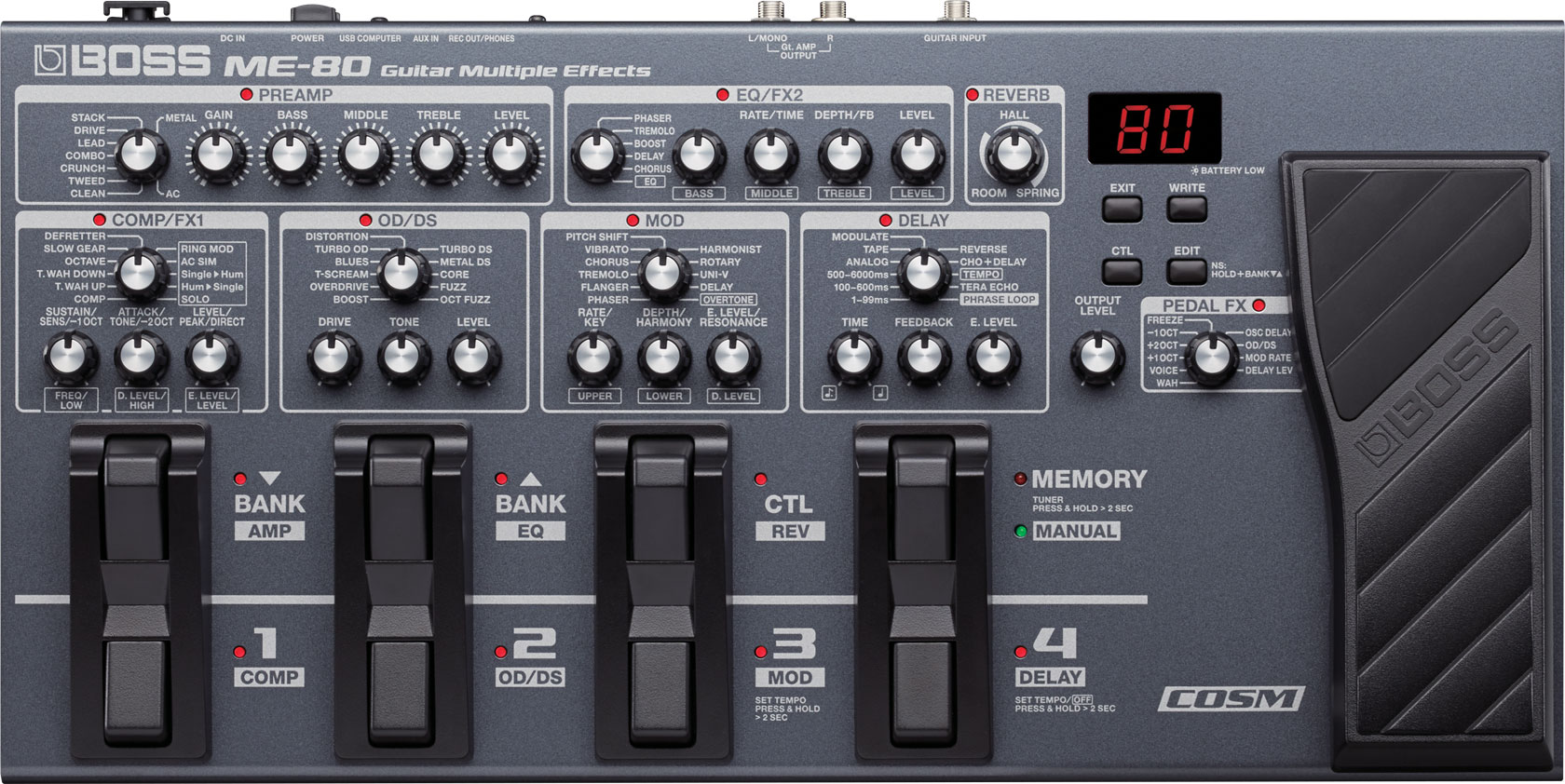

The Boss ME-80 is another great multi-effects pedal. It’s a bit more expensive than the Zoom G3N, but it offers a ton of features. It has 80 different effects, and it also comes with a built-in expression pedal for added flexibility and control. 

The Boss ME-80 is a great multi-effects pedal with lots of features that give you a ton of value for your money. And to make it easy to use, it has a very user-friendly interface. The Boss ME-80 offers 80 different effects and includes an expression pedal for added flexibility and control. 

3. Line 6 Helix


The Line 6 Helix is the most advanced multi-effects pedal on the market. It’s expensive, but it offers unparalleled flexibility and tonal options. With over 260 different effects, you can create any sound you can imagine with this pedal.

At first glance, the Line 6 Helix looks just like any other multi-effect pedal on the market. However, when you get to know it better, you realize that it’s more than meets the eye. For starters, this model has an impressive array of effects and features. 

There are over 260 different effects to choose from and this can be expanded to 280 with the purchase of a few additional expansion packs. But that’s not all this pedal has to offer. In addition to its abundant effects, the Helix can create stereo and surround sound, it can function as a USB audio interface, and it has 14 onboard preset banks for quick and easy recall. 

4. Electro-Harmonix POG2


The Electro-Harmonix POG2 is a great pedal for creating synth sounds. It has 12 different sounds to choose from, and it also has a built-in octave generator for added flexibility. The Electro-Harmonix POG2 is a great pedal for creating synth sounds. It has 12 different sounds to choose from, and it also has a built-in octave generator for added flexibility. 

The Electro-Harmonix POG2 is really easy to use and enjoyable to play with. The sound this pedal creates is amazing. Cons: The delay time can be a little bit too long, which could make the sound feel a little bit too washed out. 

The Electro-Harmonix POG2 is an easy-to-use and enjoyable pedal that creates sounds that are similar to synth sounds. It has 12 different great-sounding presets like bass, pad, and lead. It is easy to use with a simple encoder knob that lets you modify the effect parameter. 

With its small size, the Electro-Harmonix POG2 is an excellent pedal for beginners and pros alike. The Electro-Harmonix POG2 is a unique and easy-to-use analog synthesizer-style effect pedal that features 12 different preset sounds including bass, pad, and lead.

5. TC Electronic Ditto X4


The TC Electronic Ditto X4 is a great pedal for singers and songwriters. It has a built-in looper, which allows you to record and playback your guitar riffs. It also has five different storage loops, so you can save your favorite riffs for later use. The Ditto X4 has a ton of different effects as well, which can be used as standalone or in conjunction with another effect. 

It has a built-in tuner, which is great for tuning up your guitar before you start jamming. The multi-effects unit includes over 100 high-quality effects and amplifiers, like distortion, reverb, echo, wah, and more. The units also have an amp simulator that allows you to make presets similar to those of actual amps.

6. Digitech Polara

The Digitech Polara is a great pedal for beginners. It has a simple interface, and it’s easy to use. It has seven different effects to choose from, and it also has a built-in tuner for added convenience.  This pedal is simple to use, and it will give you everything you need.  

The sound quality on the Polara is great. It sounds great, and it also has a noise-reduction feature that will help maintain your level of clarity while playing. The effects are also top-notch, and they give you everything you need to get started with your pedal or to work up some new sounds.

7. MXR M75 Super Badass Distortion

The MXR M75 Super Badass Distortion is a great pedal for rock and metal guitarists. It has a ton of features that make it a great addition to any pedalboard, including clean boost and special guitar effect modes. The MXR M75 Super Badass Distortion is a great pedal for rock and metal guitarists. 

It has a ton of features that make it a great addition to any pedalboard, including clean boost and special guitar effect modes. The MXR M75 Super Badass Distortion pedal is one of the more expensive pedals on the market, but it comes with tons of features that make it a worthy investment. 

This pedal offers clean boost and effects modes, which are both favorites for guitarists. It also has a lot of knobs and settings to customize your sound, so you can find what

Other Good Guitar Pedals


Guitar pedals can be a great way to customize your sound and explore new sonic terrain. Here are a few other great pedals to check out:         
  • The Skylab Reverb Pedal is a modern take on the classic reverb pedal for guitar. It features nine different reverb types: Room, Cathederal, Shimmer, Modulated, Dark Matter, Swirl, Cloud Cover, Shimmer & Modulated and Spring.
  • The V847 Wah-Wah Pedal is an amazing product for guitarists. It is a true bypass, so it doesn't color your tone when it's off. It has a wide frequency range and can be used in almost any genre of music.
  • The Electro-Harmonix Soul Preacher is a great pedal for adding boost and grit to your sound. 
  • The MXR Carbon Copy Analog Delay is a great pedal for adding delay effects to your sound. 
  • The Boss RC-3 Loop Station is a great pedal for adding looping capabilities to your rig. 
  • The TC Electronic Hall of Fame Reverb is a great pedal for adding lush reverbs to your sound.

Conclusion


Guitarists are always in search of the best tone, and pedals are one way to get there. Some guitarists swear by multi-effects pedals because they offer a variety of sounds in a convenient package. Here are seven of the best multi-effects pedals for guitarists in 2022.

Friday, June 26, 2009

A Guide to Buying an Acoustic Guitar

Knowing how to choose the right guitar and how to identify a bad one, will save you from countless headaches, not to mention finger aches.

Acoustic guitar bodies come in basically the same hourglass shape, with some variations, but they do vary in size, color, wood-type, style, and extra features. You can even buy an acoustic guitar so small that fits into a hiking backpack.

Guitars come in a very wide range of prices, but when it comes to instruments, in general, you get what you pay for, especially when you buy new. There’s a real difference between getting a bargain and buying cheap.

But whether you buy new or used may be determined by many personal factors including your budget, and each has their own pros and cons.

Buying new, gives you a warranty and, hopefully, a return period, if for some reason you’re not totally satisfied with your purchase, or something goes wrong.

Under ‘usual' circumstances, a used guitar can usually be purchased cheaper and has already gone through its “break-in” period.

Commercially built guitars are usually mass manufactured. “Custom-made” guitars are exactly that. They are custom built and tailored to your specifications by a highly skilled guitar maker.

Prices for a custom-built guitar vary considerably, depending on the skill level of the craftsperson you contract the job to, but, as a rule, they are generally quite higher than a commercially built guitar of “similar” quality. Each custom built guitar is unique and therefore hard to compare in price to a commercially built guitar.

FOR THE "TECHIES"


Understanding some of the parts of a guitar will definitely help you when it comes to the Pre-Purchase Checklist.

BODY: This is the part with the sound hole in the front. It is where the strumming is done, and it can vary in size. The actual size, shape, type of wood, coating, and general build of the body also affects how the guitar will “sound”, whether it’s a rich and warm sound, or a thin and ‘twangy’ sound. The body tends to be the part that also gets scratched, damaged, and generally banged-up the most.

NECK: This is the long piece extending from the body and ends at the ‘head’ of the guitar where the ‘Tuning Heads’ are, also known as ‘machine heads’. The strings travel from the ‘Bridge’ on the body, across the sound hole, along the ‘Fret Board’, which is attached to the front-side of the neck, and finally arriving at the tuning heads where they are wrapped around tuning posts. The tuning heads are then turned by hand, which then turns the posts, making the strings tighter or looser, thus affecting their ‘tuning’. Necks tend to warp and twist if not looked after, or if the guitar is left propped against a heat source.

BRIDGE: The Bridge is normally located on the front of the body, by the sound hole, and on the side of the hole opposite to the neck. The strings are usually fed through the bridge first before they cross the hole and travel up the neck to the tuning heads. The bridge is like an anchor-point for the strings. Metal bridges are best, but on most acoustics they are either hard plastic or wood. Bridges have a tendency to crack and split over a long period of time.

FRET BOARD: The fret board is glued to the front of the neck. This is the part you press the strings onto to make chords or play individual notes. Because it’s glued on separately, a fret board can be made of a wood that’s different from the neck.

The strings travel over the fret board and the distance they are above the fret board makes a difference to the playability of the guitar. If the strings are too far above the fret board, then they will be hard to press down, making the guitar hard to play.

When a beginner plays a guitar, initially his or her fingertips are very soft and need to be hardened. A guitar with the strings too far above the fret board, also known as having a ‘high action’, will cause the player’s fingers to hurt so much that they are likely to put the guitar away in discouragement and possibly stop playing altogether.

STRINGS: Acoustic guitar strings, come in a wide variety of ‘flavors’. They can be made out of nylon, brass, steel, or a combination. Nylon strings are usually only found on Classical guitars and Student guitars, because they’re easier on the fingertips. They have a rich, warm sound to them.

Strings sets come in different ‘weights’, or sizes. Strings that come from a package marked ‘Heavy’ are usually quite thick in size and sound “beefy”. Strings that are light, or extra light, are very thin and usually have a brighter sound to them, but are also quieter sounding than heavy strings.

String choices are purely personal taste. Light strings are easier to press than heavy strings but also sound quite different. The more often strings are played, the dirtier they get. If a cloth isn’t run over and under them, from time to time, the sound becomes very dull

THE PRE-PURCHASE CHECKLIST


  • - Before you buy a used guitar, cost-compare against the price of a new one, unless the guitar is quite old. You could also compare its used price to other used prices by going to an online auction and either searching for the same or a similar guitar.
  • - Check the overall condition of the wood for cracks, scratches, splits, dents, chips, etc.
  • - Also check the lacquer finish for cracks and splits.
  • - Check the neck/fret board for warping and twisting. You can do this by holding the guitar flat on its back, with the sound hole facing upward. Bring the guitar up to eye-level, with the neck running away from you and the edge of the body almost touching your face. Let your eyesight skim across the front of the body and down the fret board. You should be able to see if the neck is twisted or bowing.
  • - Tune the guitar, or have the seller tune it for you.
  • - If you know how to play about five or six chords then play them. If you don’t know how to play, ask the seller to play them for you. This check ensures that the neck of the guitar is not warped, even though you couldn’t physically see it. If the neck is warped, and the guitar is properly tuned, then some of the chords will sound good, but others will sound as though the guitar is not tuned. If this happens, check the tuning again. If it persists, then don’t buy the guitar.
  • - Check the bridge of the guitar. If it’s made out of wood or plastic, make sure it’s not cracked or splitting. The bridge needs to be rock-solid, as a lot of pressure is exerted on the bridge by the strings.
  • - Check the tuning heads. Do they turn easily, or are they very stiff and hard to turn. Even with the high tension of the strings, a quality guitar will have tuning heads that are fairly easy to turn.
  • - Check the ‘action’ of the guitar. Are the strings a fair distance from the fret board? Are they easy or hard to press down at various points on the fret board?
  • - If you are buying the guitar for yourself, and you know how to play, even if you’re a beginner, then play the guitar.
  • - How does it feel?
  • - Is it easy or hard to play?
  • - Can you fit your hand around the neck/fret board comfortably to play chords?
  • - Is the guitar a comfortable size and shape for your body? Is it easy to hold?
  • - If you plan to play standing up, ask for a guitar strap.
  • - Do you like the sound, the color, etc?
  • - If you don’t play, have someone else play it for you so that you can judge what it sounds like.

WHERE TO BUY


Buying a guitar from a physical retail music store allows you to ‘test drive’ the guitar and ask more questions up front. Buying online or from a catalog may bring you more cash savings.

No matter where you buy your guitar, if you know what to look for, and spend a little extra effort in your search for that ‘perfect’ guitar, not only will your fingers thank you, but also your ears, and all those who will come to join you around the campfire, or even go to see you in concert. Who knows?

How to Play E Minor Scale on Guitar If you are new to learning guitar, you might be wondering how to play the E minor scale. There are thr...